skip to main |
skip to sidebar

Given at St. Peter's, Rome, on the 25th day of July, the feast of St. James the Apostle, in the year 1968, the sixth of Our pontificate. PAUL VI
The transmission of human life is a most serious role in which married people collaborate freely and responsibly with God the Creator. It has always been a source of great joy to them, even though it sometimes entails many difficulties and hardships.
The fulfillment of this duty has always posed problems to the conscience of married people, but the recent course of human society and the concomitant changes have provoked new questions. The Church cannot ignore these questions, for they concern matters intimately connected with the life and happiness of human beings. . . .
17. Responsible men can become more deeply convinced of the truth of the doctrine laid down by the Church on this issue if they reflect on the consequences of methods and plans for artificial birth control. Let them first consider how easily this course of action could open wide the way for marital infidelity and a general lowering of moral standards. Not much experience is needed to be fully aware of human weakness and to understand that human beings—and especially the young, who are so exposed to temptation—need incentives to keep the moral law, and it is an evil thing to make it easy for them to break that law. Another effect that gives cause for alarm is that a man who grows accustomed to the use of contraceptive methods may forget the reverence due to a woman, and, disregarding her physical and emotional equilibrium, reduce her to being a mere instrument for the satisfaction of his own desires, no longer considering her as his partner whom he should surround with care and affection.
Finally, careful consideration should be given to the danger of this power passing into the hands of those public authorities who care little for the precepts of the moral law. Who will blame a government which in its attempt to resolve the problems affecting an entire country resorts to the same measures as are regarded as lawful by married people in the solution of a particular family difficulty? Who will prevent public authorities from favoring those contraceptive methods which they consider more effective? Should they regard this as necessary, they may even impose their use on everyone. It could well happen, therefore, that when people, either individually or in family or social life, experience the inherent difficulties of the divine law and are determined to avoid them, they may give into the hands of public authorities the power to intervene in the most personal and intimate responsibility of husband and wife.
HUMANAE VITAE
http://www.vatican.va/holy_father/paul_vi/encyclicals/documents/hf_p-vi_enc_25071968_humanae-vitae_en.html

Catholic Athletes for Christ (CAC) serves Catholic athletes in the practice of their faith and shares the Gospel in and through sports. We work with athletes at all levels of sport in an effort to promote a Catholic sports culture. CAC was formed in response to Pope John Paul II's call to evangelize the world of sports and his establishment of the Vatican's Office of Sports.
As St. Paul's epistles teach us, Christ is God’s true athlete and we are made perfect when, and only when, we imitate Him. John Paul II advises us that, "Every Christian is called to become a strong athlete of Christ, that is a faithful and courageous witness to His Gospel." We invite you to join us as an "athlete for Christ."
Ray McKenna, Founder of Catholic Athletes for Christ
Our Mission: The mission of Catholics Athletes for Christ (CAC) is to serve Catholic athletes and share the Gospel of Christ in and through athletics.
Our Goal: The goal of Catholic Athletes for Christ (CAC) is to provide an integrated network of sports oriented clergy and lay people to serve Catholic athletes, coaches and staff in the practice of their faith and to utilize the unique platform given to them to reach the world for Jesus Christ and His Church.
Our Vision:
• To provide solid Catholic role models
• To work with the Church leadership and Catholic organizations
• To minister to Catholic athletes, coaches and staff
• To reverse the moral crisis in sports today
• To create a network of Catholic athletes, coaches and staff
• To organize sports conferences, pilgrimages, retreats and days of reflection
"Sport, properly directed, develops character, makes a man courageous, a generous loser, and a gracious victor; it refines the senses, gives intellectual penetration, and steels the will to endurance. It is not merely a physical development then. Sport, rightly understood, is an occupation of the whole man, and while perfecting the body as an instrument of the mind, it also makes the mind itself a more refined instrument for the search and communication of truth and helps man to achieve that end to which all others must be subservient, the service and praise of his Creator."
– Pope Pius XII, Sport at the Service of the Spirit, July 29, 1945
Catholic Athletes For Christ - CAC
http://www.catholicathletesforchrist.com/index.htm
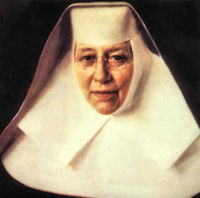
Katharine Drexel was born in Philadelphia in 1858. She had an excellent education and traveled widely. As a rich girl, she had a grand debut into society. But when she nursed her stepmother through a three-year terminal illness, she saw that all the Drexel money could not buy safety from pain or death, and her life took a profound turn.
She had always been interested in the plight of the Indians, having been appalled by reading Helen Hunt Jackson's A Century of Dishonor. While on a European tour, she met Pope Leo XIII and asked him to send more missionaries to Wyoming for her friend Bishop James O'Connor. The pope replied, "Why don't you become a missionary?" His answer shocked her into considering new possibilities.
Back home, she visited the Dakotas, met the Sioux leader Red Cloud and began her systematic aid to Native American missions.
She could easily have married. But after much discussion with Bishop O'Connor, she wrote in 1889, "The feast of Saint Joseph brought me the grace to give the remainder of my life to the Indians and the Colored." Newspaper headlines screamed "Gives Up Seven Million!" . . .
At seventy-seven, she suffered a heart attack and was forced to retire. Apparently her life was over. But now came almost twenty years of quiet, intense prayer from a small room overlooking the sanctuary. Small notebooks and slips of paper record her various prayers, ceaseless aspirations and meditation. She died at ninety-six and was canonized in 2000.
St. Katharine Drexel
http://www.catholicculture.org/culture/liturgicalyear/calendar/day.cfm?date=2009-03-03

19. On Confession
. . . Some people go on confessing venial sins out of mere habit, and conventionally, without making any effort to correct them, thereby losing a great deal of spiritual good. Supposing that you confess having said something untrue, although without evil consequences, or some careless words, or excessive amusement;-- repent, and make a firm resolution of amendment: it is a mere abuse to confess any sin whatever, be it mortal or venial, without intending to put it altogether away, that being the express object of confession.
Beware of unmeaning self-accusations, made out of a mere routine, such as, "I have not loved God as much as I ought; I have not prayed with as much devotion as I ought; I have not loved my neighbour as I ought; I have not received the Sacraments with sufficient reverence;" and the like. Such things as these are altogether useless in setting the state of your conscience before your Confessor, inasmuch as all the Saints in Paradise and all men living would say the same. But examine closely what special reason you have for accusing yourself thus, and when you have discovered it, accuse yourself simply and plainly of your fault.
For instance, when confessing that you have not loved your neighbour as you ought, it may be that what you mean is, that having seen some one in great want whom you could have succoured, you have failed to do so. Well then, accuse yourself of that special omission: say, "Having come across a person in need, I did not help him as I might have done," either through negligence, or hardness, or indifference, according as the case may be. So again, do not accuse yourself of not having prayed to God with sufficient devotion; but if you have given way to voluntary distractions, or if you have neglected the proper circumstances of devout prayer--whether place, time, or attitude--say so plainly, just as it is, and do not deal in generalities, which, so to say, blow neither hot nor cold.
Again, do not be satisfied with mentioning the bare fact of your venial sins, but accuse yourself of the motive cause which led to them. For instance, do not be content with saying that you told an untruth which injured no one; but say whether it was out of vanity, in order to win praise or avoid blame, out of heedlessness, or from obstinacy. If you have exceeded in society, say whether it was from the love of talking, or gambling for the sake of money, and so on. Say whether you continued long to commit the fault in question, as the importance of a fault depends greatly upon its continuance: e.g., there is a wide difference between a passing act of vanity which is over in a quarter of an hour, and one which fills the heart for one or more days. So you must mention the fact, the motive and the duration of your faults. It is true that we are not bound to be so precise in confessing venial sins, or even, technically speaking, to confess them at all; but all who aim at purifying their souls in order to attain a really devout life, will be careful to show all their spiritual maladies, however slight, to their spiritual physician, in order to be healed.
Do not spare yourself in telling whatever is necessary to explain the nature of your fault, as, for instance, the reason why you lost your temper, or why you encouraged another in wrong-doing. Thus, some one whom I dislike says a chance word in joke, I take it ill, and put myself in a passion. If one I like had said a stronger thing I should not have taken it amiss; so in confession, I ought to say that I lost my temper with a person, not because of the words spoken so much as because I disliked the speaker; and if in order to explain yourself clearly it is necessary to particularize the words, it is well to do so; because accusing one's self thus simply one discovers not merely one's actual sins, but one's bad habits, inclinations and ways, and the other roots of sin, by which means one's spiritual Father acquires a fuller knowledge of the heart he is dealing with, and knows better what remedies to apply.
But you must always avoid exposing any one who has borne any part in your sin as far as possible. Keep watch over a variety of sins, which are apt to spring up and flourish, often insensibly, in the conscience, so that you may confess them and put them away; and with this view read Chapters 6, 27, 29, 35 and 36. of Part 3, and Chapter 7. of Part 4 attentively.
Do not lightly change your Confessor, but having chosen him, be regular in giving account of your conscience to him at the appointed seasons, telling him your faults simply and frankly, and from time to time--say every month or every two months, show him the general state of your inclinations, although there be nothing wrong in them; as, for instance, whether you are depressed and anxious, or cheerful, desirous of advancement, or money, and the like.
Introduction to a Devoute Life (cont)
PART II. Containing sundry counsels as to uplifting the soul to God in prayer and the use of the Sacraments (cont).
19. On Confession
http://www.catholictreasury.info/books/devout_life/dev42.php
THE UNICORN WRITER, RIP
This week the world lost a rare writer at the age of 43. He was not a media fixture and certainly not one of those writers making appearances at the literary salons. He was a Dublin homebody. But what an astounding person Christopher Nolan was.
Nolan was born with cerebral palsy, could not speak, nor control his extremities. Confined to a wheelchair, he was the type of person our society looks at with pity or largely ignores. Thankfully, his family never saw him that way. They loved him unconditionally, interacted with him and taught him as one would any child. He would go on to school, though no one fully appreciated his mental acuity.
A drug was discovered that allowed Nolan to move one muscle in his neck. (Bono of U2, who attended school with Nolan wrote the song “Miracle Drug” about the boy). At the age of 11 he was equipped with a “unicorn stick” which was fastened to his head. With it Nolan would peck at a typewriter. His mother had to apply pressure to his chin to stabilize the boy’s head, allowing him to work his art. It was a torturous process, taking him more than 15 minutes to produce one word on the page. And what words they were.
He published his first book at 15, a collection of poems appropriately titled “Dam-burst of Dreams.” His second book won Britain’s prestigious “Whitbread Book of the Year:” in 1988. It was called Under the Eye of the Clock a biographical work in which he refers to himself as Joseph Meehan. At one point in the book Nolan writes of crying upon the realization that he is not like other children:
``Looking through his tears he saw [his mother] bent low in order to look into his eyes. `... Listen here Joseph, you can see, you can hear, you can think, you can understand everything you hear. You like your food, you like nice clothes, you are loved by me and Dad. We love you just as you are.' Pussing still, sniveling still, he was listening to his mother's voice. She spoke sort of matter-of-factly but he blubbered moaning sounds. His mother said her say and that was that. She got on with her work while he got on with his crying.
``The decision arrived at that day, was burnt forever in his mind. He was only three years in age but he was now fanning the only spark he saw, his being alive and more immediate, his being wanted just as he was....
``That day looked out through his eyes for the rest of his life. Comfort came in child-like notions, his clumsy body was his, but molested by mother-love he looked lollying looks at his limbs, and liked Joseph Meehan.'
Nolan was a Catholic, one who was often frustrated by his inability to open his mouth at communion time. But the mark of his faith is evident in his work. In “Under the Eye of the Clock” he wrote of Christmas:
“Bells pealed in all the Dublin churches as midnight nudged home its bashful meaning to all the crazy longing. Christ the God-child now breathed a human breath. The Word became flesh and dwelt amongst man. Manger-cradled the Saviour lay. Midnight Mass marked the moment for Joseph; crested now with knowing, he marvelled at the nobility of the human person.”
His Mother, Bernadette told the Christian Science Monitor in the late 80’s: “``He has shown (people with disabilities) that life is worth living, and it doesn't matter whether you're in a wheelchair or a bed; it's what's going on in your mind and your soul that is important.''
Beyond his somersaulting innovation with language, the thing that lingers about Nolan is the improbable miracle of the man himself. I am in awe of the great sacrifices he made each day to share his voice with the world. Each overwhelming obstacle to communication was soberly considered, and ruthlessly overcome. Of writing he once said: ``My mind is just like a spin dryer at full speed. My thoughts fly around my skull, while millions of beautiful words cascade down into my lap. Images gunfire across my consciousness and, while trying to discipline them, I jump in awe at the soul-filled bounty of mind's expanse.''
How many able bodied people put off their calling, or make needless excuses for doing nothing. The next time those deadening temptations bubble up, we should think of Christopher Nolan. With a stick affixed to his head, in a body he could not control, his mother holding his chin, Nolan managed to produce a book of poetry, a play, a novel, a biography and an incredible witness for us all.
May Christopher Nolan rest in peace.
Raymond's Blog - February 25, 2009
http://raymondarroyo.com/blog/2009/02/christopher_nolan_the_unicorn.html


