Showing posts with label Mary. Show all posts

Tuesday, July 14, 2009

Who then are you, O Immaculate Conception?

. . .

Who then are you, O Immaculate Conception?

Not God, of course, because He has no beginning. Not an angel, created directly out of nothing. Not Adam, formed out of the dust of the earth. Not Eve, molded from Adam's rib. Not the Incarnate Word, Who exists before all ages, and of Whom we should use the word "conceived" rather than "conception."

Humans do not exist before their conception, so we might call them created "conceptions." But you, O Mary, are different from all other children of Eve. They are conceptions stained by Original Sin; whereas you are the unique, Immaculate Conception.

Everything which exists, outside of God Himself, since it is from God and depends on Him in every way, bears within itself some semblance to its Creator; there is nothing in any creature which does not betray this resemblance, because every created thing is an effect of the Primal Cause.

It is true that the words we use to speak of created realities express the Divine perfections only in a halting, limited and analogical manner. They are only a more or less distant echo----as are the created realities that they signify ---- of the properties of God himself. Would not "conception" be an exception to this rule? No, there is never any such exception. The Father begets the Son; the Son proceeds from the Father and the Son. Theses few words sum up the mystery of the life of the Most Blessed trinity and of all the perfections in creatures which are nothing else but echoes, a hymn of praise of this primary and most wondrous of all mysteries.

We must perforce use our vocabulary, since it is all we have; but we must never forget that our vocabulary is very inadequate.

Who is the Father? What is His personal life like? It consists in begetting, eternally because He begets His Son from the beginning and forever.
Who is the Son? He is the Begotten-One, because from the beginning and for all eternity He is begotten by the Father.

And Who is the Holy Spirit? The flowering of the love of the Father and the Son. If the fruit of created is a created conception, then the fruit of Divine love, that prototype of all created love, is necessarily a Divine "conception." The Holy Spirit is, therefore, the "uncreated, eternal conception," the prototype of all the conceptions that multiply life throughout the whole universe.

The Father begets; the Son is begotten; the Spirit is the "conception" that springs from their love; there we have the intimate life of the Three Persons by which They can be distinguished from one another. But They are united in the Oneness of Their Nature, of Their Divine existence. The Spirit is, then, this thrice holy "conception," this infinitely holy Immaculate Conception . . .

The creature most completely filled with this love, filled with God Himself, was the Immaculata, who never contacted the slightest stain of sin, who never departed in the least from God's will. United to the Holy Spirit as His spouse, she is one with God in an incomparably more perfect way than can be predicated of any other creature.
. . .
Who then are you, O Immaculate Conception?
Excerpted and compiled from, "Immaculate Conception and the Holy Spirit",
The Marian Teachings of Fr. Maximilian Kolbe, Fr. H.M. Manteau-Bonamy, O.P. http://www.catholictradition.org/Mary/conception.htm

Novena in Honor of the Immaculate Conception
By St. Maximilian Kolbe
http://www.corazones.org/oraciones/oraciones_maria/novena_inmaculate_conception_kolbe.htm

Wednesday, June 24, 2009

I am the Immaculate Conception

Anthropological Implications for a Pedagogy of Holiness in the
Teaching of John Paul II and Father Joseph Kentenich
Danielle M. Peters

This paper was presented during the Twenty-second International Marian and Mariological Congress in Lourdes from September 4-8, 2008. The topic of the congress was: The apparitions of the Blessed Virgin Mary in history, faith and theology.
. . . Magnificat

In reciting the Magnificat, Mary expresses optimistic realism in God’s power, mercy and faithfulness. With her song Our Lady teaches us an eloquent lesson of a harmonious human-divine relationship. Father Kentenich observed that with the exception of one fragment in which Our Lady speaks of herself (cf. Lk 1:48b), “all other parts of the Magnificat … circle around the eternal God, around His way of government.”[82] What are the implications concerning a healthy human-divine relationship accentuated in and through Our Lady’s Song?

Schoenstatt’s founder pointed to today’s danger of anthromorphism. By that he referred to a person’s lack of esteem and appreciation of God’s greatness and power.[83] Mary answers to this danger by acknowledging her smallness before Almighty God. The opposite approach to God is typical for our age as well. When God is acknowledged as the totally Other and Transcendental, we fail to see the divine-human analogies.[84]

Finally, Father Kentenich observed a certain tendency of depersonalizing God.[85] This occurs when the biblical-personal God becomes an abstract idea and when love for God is replaced by merely following rules; in other words, when love for the lawgiver is replaced by love for the law.

Mary’s Magnificat highlights her personal relationship to God who is mighty, holy, merciful and capable of performing great deeds. Looking at the Immaculata, we have a presentiment of God’s holiness. Love for Him has made her the sacred space where God abides. By approaching her we find God whose name is unending, overflowing love, mercy and goodness.[86]

As object lesson, Our Lady can be likened to a book which leads heavenwards. Father Kentenich encouraged his spiritual family to frequently page in this book in order to gaze at our model whose reflection we may and should become. With her and like her our entire life should become an unending sursum corda. . . .
(by Father Joseph Kentenich)
Anthropological Implications for a Pedagogy of Holiness in the
Teaching of John Paul II and Father Joseph Kentenich
Danielle M. Peters
http://campus.udayton.edu/mary/immaculate1.html

Friday, May 15, 2009

May Feelings


May Feelings
http://www.youtube.com/watch?v=YxjjyXhO9EA

Monday, April 20, 2009

What is Schoenstatt?

This page (site) has a series of video clips that explain the key components of Schoenstatt Spirituality.
http://www.schoenstattwisconsin.org//Schoenstatt.cfm?Page=docs/About.htm

As a movement of moral and religious renewal in the Catholic Church, Schoenstatt works to help renew the Church and society in the spirit of the Gospel. It seeks to reconnect faith with daily life, especially through a deep love of Mary, the Mother of God.

As an international movement it is present on all continents and has members from all vocations and walks of life. It is a spiritual family whose many branches and communities join to form a single Schoenstatt Family.

As a place of grace, Schoenstatt has touched the lives of millions. The Schoenstatt Shrine is the movement's spiritual home and center of life. The shrine is dedicated to Mary as the Mother Thrice Admirable, Queen , and Victress of Schoenstatt. In addition to the original Shrine in Germany, there are over 180 replica daughter shrines around the world (including four in Wisconsin) where people gather for prayer, renewal, and inspiration.

http://www.schoenstattwisconsin.org//Schoenstatt.cfm?Page=docs/About.htm

Monday, March 23, 2009

WHY DID THE WORD BECOME FLESH?


I. WHY DID THE WORD BECOME FLESH?

456 With the Nicene Creed, we answer by confessing: "For us men and for our salvation he came down from heaven; by the power of the Holy Spirit, he became incarnate of the Virgin Mary, and was made man."

457 The Word became flesh for us in order to save us by reconciling us with God, who "loved us and sent his Son to be the expiation for our sins": "the Father has sent his Son as the Savior of the world", and "he was revealed to take away sins":70

Sick, our nature demanded to be healed; fallen, to be raised up; dead, to rise again. We had lost the possession of the good; it was necessary for it to be given back to us. Closed in the darkness, it was necessary to bring us the light; captives, we awaited a Savior; prisoners, help; slaves, a liberator. Are these things minor or insignificant? Did they not move God to descend to human nature and visit it, since humanity was in so miserable and unhappy a state?71

458 The Word became flesh so that thus we might know God's love: "In this the love of God was made manifest among us, that God sent his only Son into the world, so that we might live through him."72 "For God so loved the world that he gave his only Son, that whoever believes in him should not perish but have eternal life."73

459 The Word became flesh to be our model of holiness: "Take my yoke upon you, and learn from me." "I am the way, and the truth, and the life; no one comes to the Father, but by me."74 On the mountain of the Transfiguration, the Father commands: "Listen to him!"75 Jesus is the model for the Beatitudes and the norm of the new law: "Love one another as I have loved you."76 This love implies an effective offering of oneself, after his example.77

460 The Word became flesh to make us "partakers of the divine nature":78 "For this is why the Word became man, and the Son of God became the Son of man: so that man, by entering into communion with the Word and thus receiving divine sonship, might become a son of God."79 "For the Son of God became man so that we might become God."80 "The only-begotten Son of God, wanting to make us sharers in his divinity, assumed our nature, so that he, made man, might make men gods."81

Paragraph 1. The Son of God Became Man
http://www.vatican.va/archive/catechism/p122a3p1.htm

Monday, December 10, 2007

Feast of Our Lady of Loretto


Mary's flying house I, originally uploaded by Nick in exsilio.

...the holy house of Nazareth — site of the birth of the Mother of God, of Her early education and of the Annunciation by the Angel Gabriel of the wondrous news of the Incarnation of the Son of God — had been found, transported miraculously, near Tersatz in Dalmatia (Yugoslavia) on May 10th of the year 1291. Between Tersatz and nearby Fiume, the residents of the region beheld one morning an edifice, in a location where never had any been seen before. After the residents of the region talked among themselves of the remarkable little house surmounted by a bell tower, and which stood without foundations on the bare ground, describing its altar, an ancient statue of Our Lady, and other religious objects which their wondering eyes had seen within it, another surprise came to astound them once more.


More information here

Thursday, October 4, 2007

Vocation

I used to think of vocation as a static thing, the one big choice you commit to for better or worse. However, a vocation is not one-time, though it is that as seed and root. Rather it is a tree with many branches, new growths, constantly shedding and regrowing, drawn through the stages of its lifespan.

A vocation invites the newness of responding to all the present which is offered to us. Fr. Giussani gives the example of Mary who, immediately after the Annunciation, doesn't sit around and worry about what to do next, but gets up to go to Elizabeth as she has just heard from the angel that her elder cousin was expecting a baby. She wasn't ordered to do so, but we often wait around for messages instead of listening to the gentle promptings of the heart. No big announcements were made about her news; she just went about her life, following the subtlety of invitation in her own circumstances with perfect attentiveness and letting the predicament of her situation be worked out in the peace of God.

The design of God is absolutely beyond us, always; it cannot be narrowed or imprisoned within the limits of our imagination. But one who is always willing to change everything according to what God wants–and mark these words, what God wants through the circumstances, because, for Our Lady, three minutes, a minute before, it wasn’t even imaginable that the Annunciation could happen–circumstances, especially those that vex us the most, that are inevitable circumstances, these are precisely the ones that mark the road of God; the person who is open to this is not attached to anything of his own, and he’s free. So the first consequence is that he is attentive, extremely attentive to the needs of others. In fact, as soon as the Angel left, Our Lady decided right away, a girl of fourteen or fifteen years, to travel that very long journey–one that when you go to Palestine you usually do by bus or by car–of over 60 miles in the midst of that stony land, to go visit her cousin Elizabeth, because the Angel had told her that she was six months along with the child in her womb. The first thing she did was to share the need and the toil of her cousin Elizabeth, at very great sacrifice. When are you free? You’re free when you’re willing to do what God wants. Before the Infinite, only before the Infinite is man free, detached from himself. When you’re like this, you’re immediately ready to feel and meet the needs of others. What a lesson for us! These are the first characteristics of a man who lives life as a pilgrimage. (Giussani, "Mary: Faith and Faithfulness"

Friday, September 21, 2007

Aubade: The Annunciation, Thomas Merton 1946

Aubade: The Annunciation - Written in 1946


When the dim light, at Lauds, comes strike her window,
Bellsong falls out of Heaven with a sound of glass.

Prayers fly in the mind like larks,
Thoughts hide in the height like hawks:
And while the country churches tell their blessings to the
distance,
Her slow words move,
(Like summer winds the wheat) her innocent love:
Desires glitter in her mind
Like morning stars:

Until her name is suddenly spoken
Like a meteor falling.

She can no longer hear shrill day
Sing in the east,
Nor see the lovely woods begin to toss their manes.
The rivers have begun to sing.
The little clouds shine in the sky like girls:
She has no eyes to see their faces.

Speech of an angel shines in the waters of her thought
like diamonds,
Rides like a sunburst on the hillsides of her heart.

And is brought home like harvests,
Hid in her house, and stored
Like the sweet summer's riches in our peaceful barns.

But in the world of March outside her dwelling,
The farmers and the planters
Fear to begin their sowing, and its lengthy labor,
Where, on the brown, bare furrows,
The winter wind still croons as dumb as pain.


Powered by ScribeFire.

Sunday, September 2, 2007

The Design of God

The design of God is absolutely beyond us, always; it cannot be narrowed or imprisoned within the limits of our imagination. But one who is always willing to change everything according to what God wants–and mark these words, what God wants through the circumstances, because, for Our Lady, three minutes, a minute before, it wasn’t even imaginable that the Annunciation could happen–circumstances, especially those that vex us the most, that are inevitable circumstances, these are precisely the ones that mark the road of God; the person who is open to this is not attached to anything of his own, and he’s free. So the first consequence is that he is attentive, extremely attentive to the needs of others. In fact, as soon as the Angel left, Our Lady decided right away, a girl of fourteen or fifteen years, to travel that very long journey–one that when you go to Palestine you usually do by bus or by car–of over 60 miles in the midst of that stony land, to go visit her cousin Elizabeth, because the Angel had told her that she was six months along with the child in her womb. The first thing she did was to share the need and the toil of her cousin Elizabeth, at very great sacrifice. When are you free? You’re free when you’re willing to do what God wants. Before the Infinite, only before the Infinite is man free, detached from himself. When you’re like this, you’re immediately ready to feel and meet the needs of others. What a lesson for us! These are the first characteristics of a man who lives life as a pilgrimage.

Fr. Giussani, "Mary: Faith and Faithfulness"

Sunday, August 12, 2007

American Jesuit Martyrs Rose Window


Mary's Rose Window, originally uploaded by *clairity*.

Cathedral of St. Paul. "The American Jesuit Martyrs window, on the north side, commemorates the eight American martyrs."

Monday, July 16, 2007

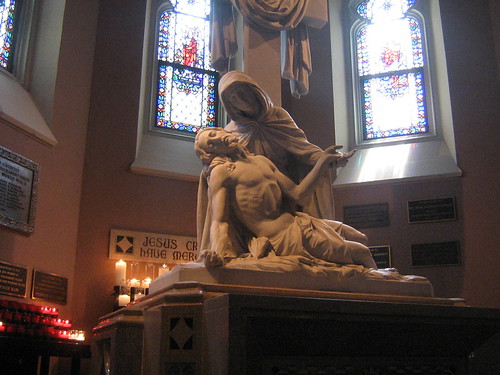
Pieta


IMG_7984, originally uploaded by Chez VH.

Blessed Sacrament Parish, Springfield, IL

Wednesday, July 11, 2007

AloysWachtRisenChrist


AloysWachtRisenChrist, originally uploaded by Edith OSB.

"Aloys Wacht, a Jewish German artist, was taken to a concentration camp. While there, he gradually converted to Catholicism. Several of his paintings hang inside the cloister of the Abbey of Saint Walburga. This image does not bear a title; the Risen Christ is with two women who appear to be Mary Magdalen (left) and Mary his Mother, (right)."

Tuesday, July 10, 2007

Our Lady of Mount Carmel

This gorgeous statue is from the Convent Church at the birthplace of St. Teresa of Avila. (click for larger view)

Friday, April 6, 2007

Pieta Mosaic, Photo


Pieta Mosaic, originally uploaded by *clairity*.

St. John Church, Rochester, MN

Mary Offering 2, Photo


Mary Offering 2, originally uploaded by *clairity*.

St. John Church, Rochester, MN

Good Friday, Poemage


Good Friday, originally uploaded by *clairity*.

This poem is based on recollections of childhood Good Friday services held in churches from 12-3pm followed by the liturgy. Sometimes we would move from one parish to another to hear different sermons.

Wednesday, April 4, 2007

Statue of Our Lady, Photo


Statue of Our Lady, originally uploaded by *clairity*.

St. Francis Church, Sacramento, CA

Monday, March 12, 2007

Fouquet's Virgin and Child Enthroned

This delicate picture is a frontispiece to Simon de Varie's personal book of hours. The other side of the page features Simon himself kneeling in prayer before Christ and his Mother. It was drawn by Jean Fouquet in 1455 in Tours and is part of the exhibit French Manuscript Illumination of the Middle Ages at the Getty Museum. What a way to get inspired for prayer!

Jean Fouquet was an important artist of his time. According to the Getty Museum,
On a visit to Rome around 1445, Jean Fouquet caused a great sensation when he painted a portrait of Pope Eugenius IV on canvas rather than the more common wood support. The momentous result of this sojourn, where he admired the work of the most innovative Italian artists of the 1400s, was that Fouquet introduced concepts and techniques of Italian Renaissance art into French painting. His subsequent work in panel painting, illuminated manuscripts, and portraiture earned him a reputation as the most important French painter of the 1400s.

The Virgin as the Burning Bush

This beautiful illumination by George Trubert of Provence (around 1480-1490) is now displayed in the exhibit French Manuscript Illumination of the Middle Ages at the Getty Museum in Los Angeles.

The theme of Our Lady depicted as the burning bush was also seen in one of the icons from the Sinai exhibit and is one of her ancient titles. She is the holy ground where God, the "I Am Who Am", is present. She is this burning place of God's visit that doesn't consume her.

Our Lady, when asked by St. Bernadette, gave her name as: "I am the Immaculate Conception." She is who God made her, wholly consecrated to him from the beginning to bring Christ to the world.

Another famous painting with this theme is explained by Rev. Theodore A. Koehler, S.M.

[I]n a very sophisticated masterpiece ["The Burning Bush"], Nicolas Froment (1475-1476) represents the biblical scene in which Moses, pasturing his sheep, was surprised to see a bush in flames and not consumed. The painter represents Moses and his sheep with the angel speaking to Moses, in the inferior part of this painting. In the center of the upper part, various rose trees merge their leaves and flowers into a great burning rosebush; in the midst, Mary is sitting with the Child Jesus. The symbolism of the Rose is enriched with the symbolic meaning attributed to the burning bush since Gregory of Nyssa: a figure of the virginal conception and birth of Christ.