Showing posts with label Church. Show all posts

Thursday, April 2, 2009

Catholic Church prepares for tens of thousands of U.S. converts

Washington D.C., Apr 1, 2009 / 04:09 am (CNA).- Tens of thousands of new Catholics are expected to join the Catholic Church in the U.S. in 2009, with many doing so at the Easter Vigil liturgies on April 11.Converts to Catholicism are known as catechumens if they have never been baptized and as candidates if they have received baptism in another Christian community and now seek full communion with the Catholic Church.

The Archdiocese of Atlanta, where Catholics have traditionally been a minority, estimates that 513 catechumens and 2,195 candidates will enter the Catholic Church in 2009, about 1,800 doing so at Easter. The figures do not include infant baptisms.

Father Theodore Book, director of the Office of Divine Worship for the Atlanta Archdiocese, said the archdiocese has been “blessed with an authentic dynamism” during recent years. He cited the archdiocese’s annual Eucharistic Congress, saying it draws nearly 30,000 participants.

“One of the many blessings that we have received from the Lord is the large number of individuals entering the Church,” he said.

The Archdiocese of Seattle will reportedly welcome 736 catechumens and 506 candidates, while the Diocese of San Diego will baptize 305 and receive into communion 920 other baptized Christians.

The mostly rural Diocese of Birmingham, Alabama reportedly will have 445 new converts. The diocese’s Cathedral of St. Paul could not hold them and their families for the Rite of Election, which had to be held in three separate ceremonies.

At St. Peter’s Basilica in Vatican City, California resident Heidi Sierras will represent North America at the Easter Vigil, where she will be baptized by Pope Benedict XVI.

The 2008 Official Catholic Directory listed 49,415 adult baptisms and 87,363 people received into full communion in 2007.

http://www.catholicnewsagency.com/new.php?n=15551

Tuesday, July 1, 2008

No Love Without Suffering

The task of proclamation and the call to suffering for Christ are inseparably together. The call to be teacher of the Gentiles is at the same time and intrinsically a call to suffering in communion with Christ, who has redeemed us through his passion. In a world in which lying is powerful, truth is paid for with suffering. He who wishes to avoid suffering, to keep it far from himself, will have pushed away life itself and its grandeur; he cannot be a servant of truth and thus a servant of faith. There is no love without suffering, without the suffering of denying ourselves, of the transformation and purification of the "I" for true freedom.

Wherever there is nothing worth suffering for, life itself also loses its value. The Eucharist -- center of our Christian being -- is based on the sacrifice of Jesus for us; it was born from the suffering of the love that found its culmination on the cross. We live from this love that gives itself. This gives us the courage and strength to suffer with Christ and for him, thus knowing that precisely in this way our life becomes great, mature and true.


Pope Benedict XVI, Homily at Pauline Year Inauguration, 6/30/08

Tuesday, January 8, 2008

The Grace of Salvation

People still tell me that the Catholic church teaches that all outside the Church are going to hell, even though Fr. Feeney's position was corrected in 1949 by Pope Pius XII. Cardinal Dulles in First Things summarizes the thorny question of salvation for those outside the Church as seen by theologians through the centuries and offers a way to reconcile the structure of every person designed with a heart meant for God and our need for the saving grace of the Catholic Church.

Scripture itself assures us that God has never left himself without a witness to any nation (Acts 14:17). His testimonies are marks of his saving dispensations toward all. The inner testimony of every human conscience bears witness to God as lawgiver, judge, and vindicator. In ancient times, the Jewish Scriptures drew on literature that came from Babylon, Egypt, and Greece. The Book of Wisdom and Paul’s Letter to the Romans speak of God manifesting his power and divinity through his works in nature. The religions generally promote prayer and sacrifice as ways of winning God’s favor. The traditions of all peoples contain elements of truth imbedded in their cultures, myths, and religious practices. These sound elements derive from God, who speaks to all his children through inward testimony and outward signs.

The universal evidences of the divine, under the leading of grace, can give rise to a rudimentary faith that leans forward in hope and expectation to further manifestations of God’s merciful love and of his guidance for our lives. By welcoming the signs already given and placing their hope in God’s redeeming love, persons who have not heard the tidings of the gospel may nevertheless be on the road to salvation. If they are faithful to the grace given them, they may have good hope of receiving the truth and blessedness for which they yearn.

The search, however, is no substitute for finding. To be blessed in this life, one must find the pearl of great price, the treasure hidden in the field, which is worth buying at the cost of everything one possesses. To Christians has been revealed the mystery hidden from past ages, which the patriarchs and prophets longed to know. By entering through baptism into the mystery of the cross and the Resurrection, Christians undergo a radical transformation that sets them unequivocally on the road to salvation. Only after conversion to explicit faith can one join the community that is nourished by the Word of God and the sacraments. These gifts of God, prayerfully received, enable the faithful to grow into ever greater union with Christ.


Powered by ScribeFire.

Monday, January 7, 2008

A Coalition of Christians and Secularists to Protect the Child

In the post "Let No One Touch the Child." The Church Blesses the Worldwide Moratorium on Abortion from Chiesa comes a report on a remarkable new momentum in Europe, a surprising coalition of believers and secularists, who are joining to support life. The insistence of the Church from the Pope to the faithful on the value of human life has not gone unheard and has touched those who recognize the moral law.

This article discusses the influence of Pope Benedict in the political realm for the defense of human dignity and can be a model for our own efforts. We should look not only to Christians but to all men and women of good will in building a society that protects the person. What we propose is not a theocracy, but a free society that respects the dignity of the human person and the natural structure of the family.

Note also that the Church's support for the UN moratorium on capital punishment was the first step; the proposed moratorium on abortion followed that action. An uncompromising respect for all human life is persuasive and builds on values already recognized. This demonstrates the quote I offered earlier from Pope John Paul II: "The Christian faith is an integral unity, and thus it is incoherent to isolate some particular element to the detriment of the whole of Catholic doctrine."


Benedict XVI made the family the focus of his message to the world for the Day of Peace celebrated on January 1, on the family as the "primary agency of peace."

The Catholics of Spain also dedicated a day to the support of the family, with a grandiose Sunday gathering in Madrid on December 30. A similar mass Family Day was held in Italy, in Rome, last May 12. The next appointment will perhaps be in Berlin, in the heart of de-Christianized Europe.

The Madrid gathering was strongly marked by the Church. It unfolded as an immense outdoor liturgy, presided over by bishops and cardinals, and offered for the observation and reflection of all. The central moment was a television linkup with the pope, who at the Angelus, from Rome, spoke directly to the crowd in Spanish.

On May 12, 2007, in Rome, the square outside of Saint John Lateran was also filled mainly with Catholics. But it was not the hierarchy of the Church that called and presided over that Family Day. It was, instead, a citizens' committee headed by Savino Pezzotta, a Catholic, and Eugenia Roccella, a feminist of radical secularist formation. Also speaking from the stage were Giorgio Israel, a Jew, and Souad Sbai, a Muslim. The form of family presented for the attention and care of all was not primarily the one celebrated by the Christian sacrament, but the "natural union between man and woman" inscribed in the civil constitution.

An initiative that goes against the grain even more emerged in Italy, during the recent Christmas festivities: the promotion of a worldwide moratorium on abortion, after the moratorium on the death penalty approved by the United Nations on December 18....

The Church of Benedict XVI, Ruini, and cardinal Angelo Bagnasco, the current president of the Italian bishops' conference, has thus looked very favorably on the fact that a non-Catholic like Ferrara has taken the initiative of launching the moratorium on abortion.

Because in effect, this is what has happened. Ferrara launched his first appeal in favor of the moratorium on abortion on the television program "Otto e mezzo," the same evening as the UN's approval of the moratorium on the death penalty, December 18.

The following day, December 19, this appeal appeared in print in "il Foglio." The afternoon of that same day, "L'Osservatore Romano" published on the front page an interview with cardinal Renato Martino, president of the pontifical council for justice and peace:

"Catholics do not consider the right to life as something that can be negotiated on a case-by-case basis, or partitioned. [...] The clearest example is that of the millions and millions of killings of certainly innocent human beings, unborn babies."

On December 20, "Avvenire," the newspaper of the Italian bishops' conference, gave its full support to the moratorium on abortion, with a front-page editorial by Marina Corradi and an interview with Ferrara.

On December 21, Ferrara announced that he would be fasting from Christmas Eve to the first day of the new year, in support of public financing for the Life Assistance Centers (CAV's) that help mothers who are tempted to have abortions.

In effect, during the following days the Lombardy Region and the municipal government of Milan supplied 700,000 euro to the CAV at Mangiagalli, the Milanese clinic that performs the greatest number of abortions. Last year at this clinic, the CAV was responsible for 833 births, by helping mothers in difficulty. In total, it is calculated that all of the CAV's operating in Italy have saved about 85,000 babies from abortion from 1975 until today.

Meanwhile, pages and pages of "il Foglio" have been filled with letters in support of the moratorium. A growing, unstoppable torrent of letters. Some are simple expressions of agreement, but most of them include sophisticated reflection, stories, experiences of fathers and mothers, painful accounts, and enthusiastic endorsements. Hundreds, thousands of letters in which the absolute protagonist was the tiny little being formed from conception – welcomed, loved, exalted. It is difficult to imagine a Christmas celebrated with music more appropriate than this concert of letters....

But what does the moratorium on abortion propose in practical terms? Ferrara dreams of "five million pilgrims of life and love, all in Rome next summer." To ask for two things from governments all over the world: first, to "suspend every policy that provides an incentive for the practice of eugenics"; second, to "write into the universal declaration of human rights the right to be born." With a manifesto prepared by personalities of various perspectives, like Didier Sicard of France, Italy's Carlo Casini, Roger Scruton, from England, the American bioethicist Leon Kass, and the new U.S. ambassador to the Holy See, Mary Ann Glendon, "naturally excluding any form of blame, and far more any legal persecution of women who may decide to have an abortion" as permitted by the laws in effect in the various countries.

On the evening of December 31, interviewed on a widely popular television news program, cardinal Ruini summarized the Church's position as follows:

"I believe that after the good result obtained in regard to the death penalty, it is very logical to recall the topic of abortion and ask for a moratorium, at least to stimulate and awaken the consciences of all, to help people to realize that the baby in the mother's womb is truly a human being, and that its suppression is inevitably the suppression of a human being.

"In the second place, it may be hoped that this moratorium will also provide a stimulus for Italy, at least for the complete application of the law on abortion, which claims to be a law intended for the defense of life, and then to apply this law in those areas that can truly be in defense of life, and perhaps, thirty years after the passage of this law, to update it in keeping with the scientific progress that, for example, has made great steps forward in regard to the survival of premature babies. It becomes truly inadmissible to proceed with abortion at a point where the fetus could survive outside of the womb."


Powered by ScribeFire.

Wednesday, November 28, 2007

The Newest Missionary Venture

Don't miss this week's article by John Allen on a fledgling missionary operation in Mongolia. It's a fascinating subject: a brand new territory for Christian evangelization, Mongolia, just started in 1992 by a Filipino priest, now bishop. To date there are about 400 Christians.

The attraction for the new Christians has come simply from the liturgy (in the vernacular) and from the social relief programs.

Padilla said that when he conducts interviews with Mongolian converts to understand what attracted them and made them decide to join the church, most will say they first came into contact with Catholicism through one of its social programs – a school, soup kitchen, or relief center. What “hooked” them, however, was the liturgy.

“They say it’s the singing, the liturgy,” Padilla told an audience at the Oratory of St. Francis Xavier del Caravita in Rome. “They say it’s more worthwhile than what they experience in the Buddhist temple. They’re active in the prayers and in the singing, It’s not just the monks doing all the singing.”

Padilla said that even though the four parishes in Mongolia (and four parochial sub-stations) use largely Western liturgical music, it’s translated into the vernacular, and most of the liturgy now is also said using the Mongol language. That, too, he said, is a major point of entry for new converts, most of whom are young and from the middle class or below.

“We cater mostly to the young and to the very poor,” Padilla said.


Bishop Padilla also found a strategy to soften up the local officials to get church building permits.

[A] Belgian missionary who had served in Inner Mongolia explained to him how to get things done.

“He told me that when you’re in difficulty, the thing to do is to invite these officials to dinner and get them drinking, especially vodka,” he said.

“It worked, but it was rough. At one point, I was drunk at least once or twice a week. One time I had to leave my car behind because I was too drunk to drive … but God will forgive, and anyway I wasn’t a bishop yet!”


Actually, Jesus attended a lot of parties from all accounts.

Building the Kingdom may not be so complicated as we tend to think.


Powered by ScribeFire.

Sunday, November 4, 2007

Description of an Imploding Society

In a recent address, Denver Archbishop Chaput offered some historical observations with an application to where we are today. The book he recommends on the subject, Rodney Stark's The Rise of Christianity, has been recommended to me by others as well.
This society is advanced in the sciences and the arts. It has a complex economy and a strong military. It includes many different religions, although religion tends to be a private affair or a matter of civic ceremony.

This particular society also has big problems. Among them is that fertility rates remain below replacement levels. There aren't enough children being born to replenish the current adult population and to do the work needed to keep society going. The government offers incentives to encourage people to have more babies. But nothing seems to work.

Promiscuity is common and accepted. So are bisexuality and homosexuality. So is prostitution. Birth control and abortion are legal, widely practiced, and justified by society's leading intellectuals.

Every now and then, a lawmaker introduces a measure to promote marriage, arguing that the health and future of society depend on stable families. These measures typically go nowhere.

Ok. What society am I talking about? Our own country, of course, would broadly fit this description. But I'm not talking about us.

I've just outlined the conditions of the Mediterranean world at the time of Christ. We tend to idealize the ancients, to look back at Greece and Rome as an age of extraordinary achievements. And of course, it was. But it had another side as well.

We don't usually think of Plato and Aristotle endorsing abortion or infanticide as state policy. But they did. Hippocrates, the great medical pioneer, also famously created an abortion kit that included sharp blades for cutting up the fetus and a hook for ripping it from the womb. We rarely connect that with his Hippocratic Oath. But some years ago, archeologists discovered the remains of what appeared to be a Roman-era abortion or infanticide "clinic." It was a sewer filled with the bones of more than 100 infants.


Powered by ScribeFire.

Wednesday, October 31, 2007

Stafford on the Freedom of Indifference

Here's an interesting piece from an interview with Cardinal Francis Stafford of Denver, who just celebrated his golden jubilee.

Q: What's the most significant change in the Catholic Church in the last 50 years?

A: On the positive side, lay people are actively in search of holiness; not a cheap holiness, not a holiness that comes from an inexpensive grace. Wallace Stevens, one of the great poets of the 20th century and a convert to Catholicism on his death bed, wrote, and I paraphrase: Sanctity is produced out of the condition of winter, that is a wintry cold climate. He describes a holiness produced out of a mind of winter....

On the negative side, what has changed is the self-inflicted and mortal wound of many Catholic universities and colleges that have attempted to live in two diametrically opposed cultural worlds; one, a culture based upon freedom as the pursuit of excellence and the other, freedom of indifference. The first is from the tradition of St. Augustine and St. Thomas and the other is from the period of the Enlightenment beginning with Kant.


Powered by ScribeFire.

Tuesday, October 30, 2007

Pressure on Church Institutions

Cardinal Pell of Australia discussed the challenges to Church institutions coming from "anti-discrimination" laws favoring homosexual lifestyles.

At the heart of this attack on the concept of exemptions for faith-based agencies lies a false analogy drawn between alleged discrimination against homosexuals and racial discrimination, and this is already beginning to appear in Australia.

This analogy allows opponents of exemptions to dismiss the objection that the law makes exceptions all the time - for example, for halal abattoirs, or for Sikhs to wear turbans, or for pacifists to avoid military service - by pointing to the legitimate absence of exceptions in laws against racial discrimination. Opposition to same-sex marriage is therefore likened to support for laws against inter-racial marriage (which continued in some US states until the 1960s), and opposition to homosexual adoptions is likened to refusing to adopt children to black parents.

The analogy is false because allowing blacks and whites to marry did not require changing the whole concept of marriage; and allowing black parents to adopt white children, or vice versa, did not require changing the whole concept of family, or for that matter, the whole concept of childhood. Same-sex marriage and adoption changes the meaning of marriage, family, parenting and childhood for everyone, not just for homosexual couples. And whatever issues of basic justice remain to be addressed, I am not sure that it is at all true to say that homosexuals today suffer the same sort of legal and civil disadvantages which blacks in the United States and elsewhere suffered forty years ago, and to some extent still suffer.


Powered by ScribeFire.

An Historic Ordination in Russia

From Whispers in the Loggia:

On Saturday, before a cathedral packed with Italians and Russians, Catholics and Orthodox alike, the Italian-born cleric Paolo Pezzi was ordained archbishop of "Mother of God" of Moscow, as the Latin-rite community in the Russian capital is known.

A member of the priestly arm of Comunione e Liberazione -- Benedict XVI's favorite "new movement" -- the 47 year-old archbishop served until his September elevation as a seminary rector in St Petersburg. He succeeds Archbishop Tadeusz Kondrusiewicz, who was returned to the top hierarchical post in his home country of Belarus. The departing Moscow prelate -- who's spoken in interviews of his regret at not being able to forge better coexistence with the dominant and influential Russian Orthodox church -- served as principal consecrator at the three-hour long liturgy.

Reflecting the Roman consensus that Pezzi's appointment would offer yet another sign of Vatican goodwill to the Russian Orthodox, a high-ranking representative of the Moscow Patriarchate attended the liturgy and offered a message from Patriarch Alexei II which expressed hopes for improved relations between the two churches and an "early resolution" of the issues that divide them.


Powered by ScribeFire.

Sunday, October 28, 2007

Start Blogging!

Cardinal Ruini, in a speech to religious, urged them to use the internet to reach young people on the authentic message of Christ. From Zenit.

"A priest from Novara told me that the theme of 'Jesus' is very much discussed by youth in blogs. The focus, though, comes from destructive books that are widespread today, and not from Benedict XVI’s book ‘Jesus of Nazareth.'

"What will the idea of Christ be in 10 years if these ideas triumph?"

The 76-year-old prelate admitted, "I don’t understand the Internet, but especially young religious ought to enter blogs and correct the opinions of the youth, showing them the true Jesus.”


Powered by ScribeFire.

Saturday, October 27, 2007

In Africa, Religious Harmony

Here's a beautiful story from Africa about mutual religious respect between Muslims and Christians, via Whispers in the Loggia.

The senior African prelate heading into the papal senate next month is 70 year-old Archbishop Theodore-Adrien Sarr of Dakar in Senegal. Ordained a bishop at 37 and named to the capital see of the West African nation in 2000, the cardinal-designate follows his princely predecessor Hyacinthe Thiandoum, who was given his red hat in 1974 and died three years back.

What marks Sarr out, however, is his status as the top hierarch of a nation whose population is 95 percent Muslim. What's more, relations between Islam and the church in Senegal are reported to be unusually strong, cooperative and reciprocal.

As evidence of this, after his nomination was made public the cardinal-designate noted that his elevation had been sought in prayer... by one of the country's senior imams:

The Senegalese prelate disclosed hours after his nomination that Muslim cleric Habibou Tall had predicted publicly he would be made a cardinal before the end of the year.

"He said he was going to pray for that to happen," Sarr told reporters. "I know he has prayed for that to happen and I thank him for that."...


Powered by ScribeFire.

Monday, April 9, 2007

Monastic Musings: New Members of the Family
(Easter Prayer of the Church)

From Monastic Musings: New Members of the Family
(Easter Prayer of the Church)
:

Today's prayer begins:

Father, you give your Church constant growth
by adding new members to your family.


This immediately calls to mind the thousands of people around the world who were baptized, received into full communion, or confirmed at the Easter Vigil. But notice the language of the prayer and the dynamic that it points out.

The first line is universal: it is the Church that receives constant growth. But the second line is very personal: new members are added, one by one, not to an institution or an organization, but to God's own family. Each of these people heard God's call in some way: but then met the people of God in a local parish, and studied, prayed and searched alongside those people. At the Easter Vigil, these new members were touched and prayed over and sealed into the local family of the Church. The message is clear: salvation is not about the individual and Christ, it is about the whole family that is gathered around Christ.

Monday, March 26, 2007

The Way of the Cross

The Way of the Cross or Stations of the Cross is an ancient devotion in the Church which began as a pilgrimage to the holy sites of Christ's passion. Our Lady was said to have visited these places daily. The Via Dolorosa pilgrimage has a tradition that dates back to the time of Constantine, which consisted of visiting and praying at these religious shrines in Jerusalem. The holy places of the Via Dolorosa of Jerusalem are depicted with paintings, photos and a map at the Christus Rex site.

The earliest use of the word Stations, as applied to the accustomed halting-places in the Via Sacra at Jerusalem, occurs in the narrative of an English pilgrim, William Wey, who visited the Holy Land in 1458 and again in 1462, and who describes the manner in which it was then usual to follow the footsteps of Christ in His sorrowful journey. It seems that up to that time it had been the general practice to commence at Mount Calvary, and proceeding thence, in the opposite direction to Christ, to work back to Pilate's house. By the early part of the sixteenth century, however, the more reasonable way of traversing the route, by beginning at Pilate's house and ending at Mount Calvary, had come to be regarded as more correct, and it became a special exercise of devotion complete in itself.(Catholic Encyclopedia, "Way of the Cross")

In medieval Europe, when the Holy Lands became inaccessible due to war, local Stations of the Cross arose as a public and private devotion developed from these original pilgrimages, and artists depicted these passion events in pictures and sculptures for churches. Pilgrims then walked from station to station, reciting prayers, meditations and songs. The medieval hymn Stabat Mater Dolorosa is still frequently sung for public stations of the cross.

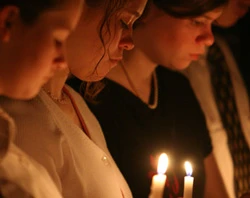
On Good Friday, public Processions of the Cross will take place all over the US and in many places around the world. The Communion and Liberation movement has adopted this ancient Church custom as a key event of the year. For information on locations of the Way of the Cross, including most of the major cities of the U.S., visit the CL national website. The New York procession starts from the Brooklyn Bridge and continues downtown to Ground Zero and has gathered thousands of participants since 9/11.

Way of the Cross, Good Friday, April 6, 2007 throughout the US

Lenten Companion: Illustrated Online Stations of the Cross

Christus Rex Via Crucis Jerusalem

Catholic Encyclopedia, "Way of the Cross"

Stations of the Cross at the Colosseum, led by Pope John Paul II, Good Friday 2000

Way of the Cross
Friday, February 9, 2007

The Christian Concept of Progress

In an interview with Zenit, Father Thomas Williams discussed Pope Paul VI's encyclical Populorum Progressio.
As Christians we believe that each of us has a specific vocation and a mission to fulfill. In this context, progress means doing our part to bring about the Kingdom of Christ in human society.

Finally, the progress of the earthly city does not exhaust the human condition. No matter how much human society progresses, our temporal existence will come to an end. We are called to eternal life in Christ. True progress must take into account man's spiritual dimension and transcendent vocation as a child of God destined for heaven.